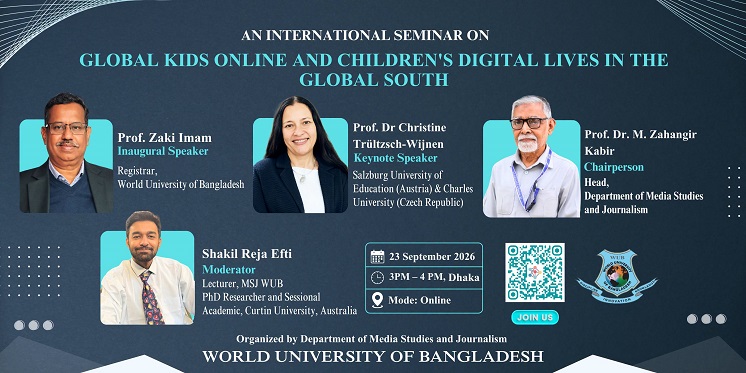
The Department of Media Studies and
Journalism (MSJ) at World University of Bangladesh (WUB) organised an
international seminar titled “Global Kids Online and Children’s Digital
Lives in the Global South” on September 23. The online seminar brought
together academics and students to discuss children’s digital experiences,
online safety, digital media use, and the challenges of developing
child-centred policies across different cultural contexts.
Prof. Zaki Imam, Registrar of WUB,
delivered the inaugural speech, while Prof. Dr Christine Trültzsch-Wijnen,
Professor at Salzburg University of Education, Austria, and Charles University,
Czech Republic, delivered the keynote presentation. Shakil Reja Efti,
Lecturer in the Department of Media Studies and Journalism at WUB, PhD
Researcher, and Sessional Academic at Curtin University, Australia, moderated
the programme.
In her keynote presentation, Prof.
Dr Christine Trültzsch-Wijnen discussed research on children’s digital
lives in Europe and emphasised the importance of understanding children’s media
use within its broader social and cultural context. Referring to Bronfenbrenner’s
social-ecological model, she explained how individual characteristics,
family, peers, community, and the wider society influence children’s digital
engagement.
She also introduced the Global
Kids Online project, an international research initiative focused on
children’s rights and experiences in the digital environment. She noted that Bangladesh
is not currently a participating country in the project.
Prof. Dr Christine further
highlighted the importance of considering local contexts when developing
policies for children’s digital safety. She explained that policies developed
in the Global North may not always be directly applicable to countries in the
Global South due to differences in culture, economic conditions, technological
access, social norms, and patterns of media use.
Using the use of generative AI among
young people in Austria as an example, she demonstrated how factors such as
widespread access to mobile internet and affordable data services can influence
digital behaviour. She emphasised that such contextual factors should be
carefully considered when making international comparisons of children’s and
young people’s digital lives.
In his inaugural remarks, Prof.
Zaki Imam highlighted concerns surrounding children’s growing presence in
digital spaces, including online exploitation and other forms of harm. He
stressed the importance of cooperation among universities, policymakers, and
international organisations to develop effective measures to protect children
while enabling them to benefit from digital technologies.
The discussion also explored digital
safety in the context of Bangladesh. Prof. Dr Christine emphasised the
importance of education and digital literacy rather than simply restricting
or banning digital technologies. Students actively participated in the
discussion and raised questions regarding the implementation of digital safety
measures in Bangladesh, as well as the ethical challenges of conducting
cross-cultural research involving children, including issues related to
consent, privacy, the digital divide, and intersectionality.
The seminar concluded with an
emphasis on the importance of qualitative research that directly engages
with children to better understand their everyday digital experiences. The
programme also created opportunities for future collaboration between WUB and
the Global Kids Online network.
Prof. Zaki Imam expressed interest
in developing a research team at WUB to work on children’s digital safety and
participate in international research initiatives. Prof. Dr Christine
Trültzsch-Wijnen indicated that she could provide guidance and support to the
WUB team if the university proceeds with participation in the Global Kids
Online project.